
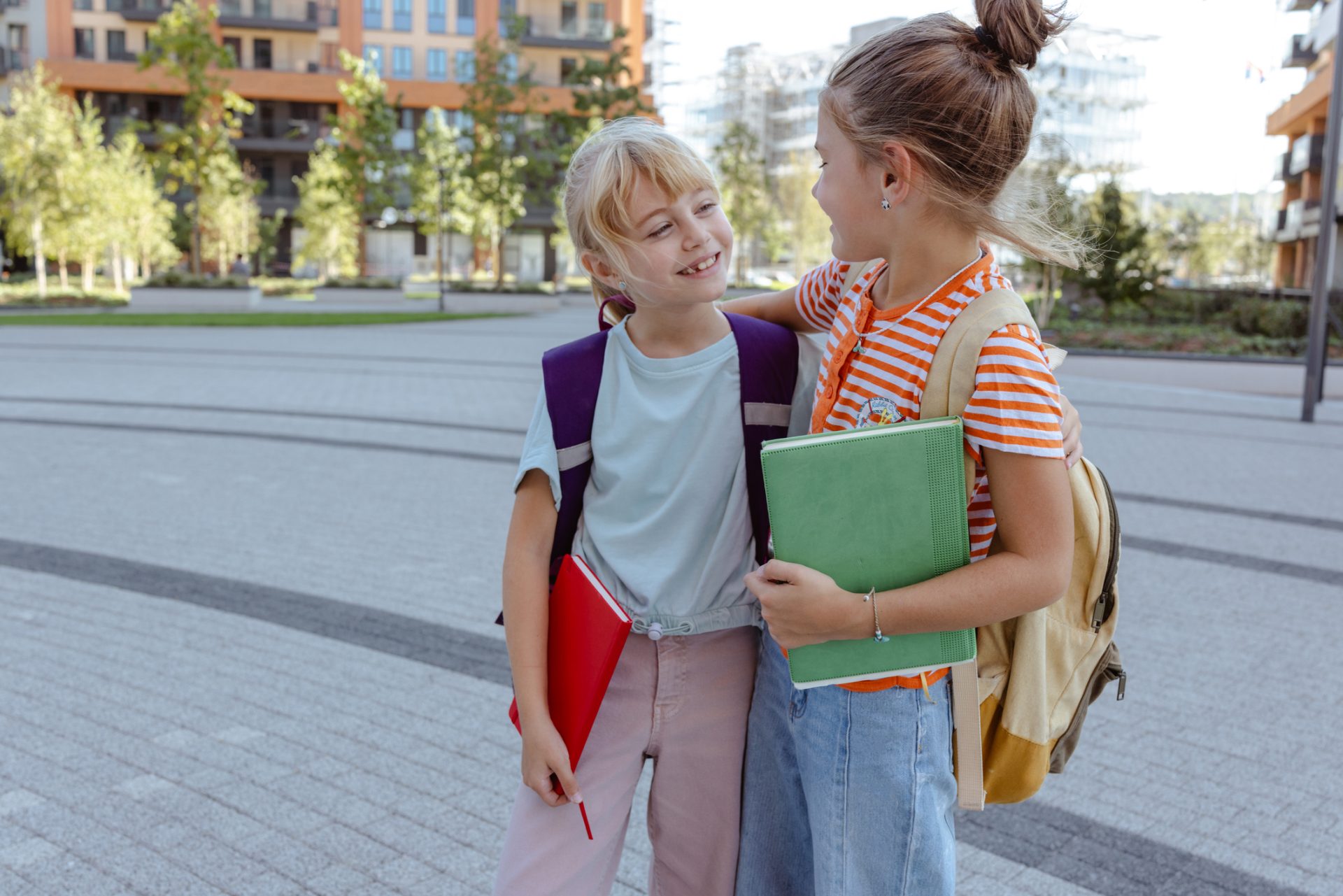
“My kid isn’t in the same class as their best friend.”
Every August, thousands of parents gasp when they see the class list. It’s usually followed by a rush in internal questions, or reaching out to the group chat… “Should I ask the school to change it?” “Will my child be lonely?” “Did the school make a mistake?”
If you’re reading this because the class lists just came out and your heart dropped when you couldn’t find your kid’s best friend on the same class list, I understand.
I really do. Because I have two very different kids.
Two Kids, Two Very Different Reactions
One of them could walk into a room where she doesn’t know a single person and leave with three new best friends. She’s outgoing, confident and the kind of kid who can strike up a conversation with just about anyone.
My other kid is different.
She’s thoughtful and kind, but friendships have never come quite as easily. She’s the kid who notices when everyone else has already paired up. The one who quietly wonders who she’ll sit beside at lunch or whether someone will ask her to play at recess. When she finds a friend she truly connects with, that friendship becomes her safe place.
So when the class lists came out one year, I found myself reacting to each child completely differently.
For my outgoing kid, I barely glanced at the names. For my quieter kid, my heart immediately started racing.
Would she be okay? Would she feel lonely? Would she spend the first few weeks watching everyone else reconnect while she tried to find her place?
It took me longer than I’d like to admit to realize something important. I wasn’t actually worried about the classroom assignment. I was worried about loneliness.
Those are two very different things.
How Do Schools Decide Which Class Your Child Will Be In?
It’s easy to imagine that schools simply divide students evenly and hope for the best.
The reality is much more thoughtful.
Long before class lists are posted, teachers and administrators spend hours, and often days, carefully creating balanced classrooms. They’re trying to build learning environments where every child has the best opportunity to succeed, not just academically, but socially and emotionally as well.
What Teachers Consider When Creating Class Lists
That means they’re considering far more than friendships.
They look at learning styles, classroom dynamics, behavioural needs, academic balance, support services, personalities and group dynamics. They consider which students work well together, which combinations create distractions and whether certain children should be separated because of ongoing conflict or bullying.
Friendships are certainly part of the conversation, but they’re only one piece of a much larger puzzle.
No classroom placement will ever feel perfect for every family because schools are balancing the needs of dozens of children at once. As hard as it can be to remember in the moment, these decisions are rarely random.
They’re usually made with incredible care.
Why Do Schools Separate Best Friends?
This is probably the question parents ask most often, and the answer isn’t because schools want to make children unhappy.
In fact, the opposite is usually true.
The Benefits of New Friendships
Teachers know that strong friendships are important. They also know that kids grow when they’re given opportunities to build new relationships. Sometimes two best friends are wonderful together, but sometimes they spend more time chatting than listening.
Sometimes one child becomes overly dependent on the other to navigate the school day. Sometimes a friendship unintentionally becomes exclusive, making it harder for other kids to join in.
By placing close friends in different classrooms, schools create opportunities for children to discover new classmates, develop confidence in unfamiliar situations and learn that friendship isn’t limited to one person.
That doesn’t mean existing friendships disappear. Kids still see one another at recess, before school, after school, during lunch, and in extracurricular activities.
They’re simply adding to their world instead of keeping it exactly the same.
But My Kid Isn’t the Outgoing One 🙁
This was the part I struggled with. Every article that cheerfully said, “They’ll make new friends!” felt like it had been written for my first child. Not my second. Because making friends isn’t equally easy for every kid.
Different Kids Have Different Friendship Styles
Some children naturally drift from group to group, collecting friendships wherever they go.
Others build friendships slowly.
They need time before they feel comfortable enough to join a game or start a conversation. They often have one or two very close friends instead of a large circle, and those friendships become deeply important.
Neither approach is better. They’re simply different ways of moving through the world.
As parents, though, we tend to project our own fears onto the situation.
When I saw my quieter kid separated from her closest friend, I immediately imagined the worst.
I pictured lonely recesses. Silent lunches. My kid standing awkwardly on the edge of the playground while everyone else laughed together.
But those images weren’t based on reality. They were based on my own anxiety.
How New Friendships Form
Child development experts have long recognized that friendships often form simply because children spend time together. Research has shown that proximity plays a powerful role in friendship development, meaning children are far more likely to become friends with classmates they regularly interact with.
In other words, sitting beside someone every day, working on projects together and sharing classroom experiences naturally create opportunities for connection.
The kids my daughter will meet this year won’t be strangers forever. They were simply friends she hadn’t made yet.
That thought changed everything for me.
Not because it erased my worries, but because it reminded me that growth often begins with uncertainty. And sometimes, as parents (especially overthinkers like me), uncertainty is much harder on us than it is on our kids!
When Should You Ask the School to Change Your Kid’s Class?
When you see your kid’s name on a class list without their best friend beside it, the first instinct is often to fix it.
I know that feeling.
Your brain immediately starts looking for solutions. Maybe the school didn’t realize how important this friendship is. Maybe one email could make everything easier.
When Speaking Up Makes Sense:
Parents know their kids better than anyone. If there are concerns about bullying, ongoing conflict, safety, learning needs, medical needs or emotional supports that the school may not fully understand, speaking up matters. Those are the situations where a classroom placement conversation can be important.
But there is a difference between protecting our children from something harmful and protecting them from something uncomfortable.
That difference is where many parents, myself included, struggle.
Not being placed with a best friend can feel like a huge loss in the moment. For some kids, that friendship represents safety. It represents the person who knows them, who saves them a seat and who makes walking into a new classroom feel less scary.
But schools also know that children grow through relationships with many different people. A classroom is not just a place where children learn math and reading. It is where they learn how to join a group, start a conversation, solve disagreements and discover that they can belong in more than one place.
When teachers create classroom groups, they are looking at the bigger picture. They are thinking about the balance of the entire classroom, not just one friendship. They are considering personalities, learning styles, student needs and classroom dynamics.
Sometimes that means keeping close friends together because that friendship supports the child.
Sometimes it means separating them because it creates an opportunity for growth.
Why Schools Sometimes Separate Best Friends
As a parent, I saw one thing: my daughter losing the comfort of a familiar friend. The school saw something else: a child who might have the opportunity to build confidence in a new environment.
Strong friendships are incredibly important for kids. They provide security, belonging and emotional support. But there is also value in helping kids discover that they can connect with people outside their existing circle.
Sometimes two children become such a close pair that they unintentionally stop reaching outward. They aren’t doing anything wrong. It is completely natural for kids to gravitate toward someone who makes them feel comfortable.
But when children are placed with new classmates, they are given a chance to discover different personalities, different interests and different friendships.
What If My Child Is Not Good at Making Friends?
This was the question I worried about most.
Because not every child walks into a new classroom and immediately finds their people.
Some children are naturally social. They can enter a room full of unfamiliar faces and start a conversation without a second thought.
Other children need time.
They watch before they join. They listen before they speak. They might have one or two close friendships rather than a large group of friends.
As parents, we sometimes mistake those differences for a problem.
But children have different friendship styles, just like they have different learning styles and different personalities.
My outgoing child collects friendships quickly.
My quieter child builds them carefully.
One is not better than the other.
The important thing is that both kids have opportunities to feel connected.
For kids who find friendships harder, a new classroom can feel intimidating at first. They may need extra reassurance. They may need reminders that friendships take time. They may need help finding small opportunities to connect.
Your Kid Is Watching How You React
This may be the most important thing I learned. When my daughter saw the class list, she looked at my face before she reacted to the names.
She was checking me. Was this good news? Was this bad news? Should she be worried?
Validating Feelings Without Creating Fear
Kids take emotional cues from the adults they trust most. If we respond with panic, they often absorb that fear. If we respond with confidence, we give them space to discover how they feel for themselves.
That doesn’t mean dismissing their disappointment.
If your kid is sad, they deserve to hear, “I know you really wanted to be with your friend. It makes sense that you’re disappointed.”
But they also deserve to hear, “I can’t wait to see who you meet this year.” There is a big difference between validating a feeling and confirming a fear.
Our children don’t need us to pretend every change is easy. They need us to believe they are capable of handling it.
