
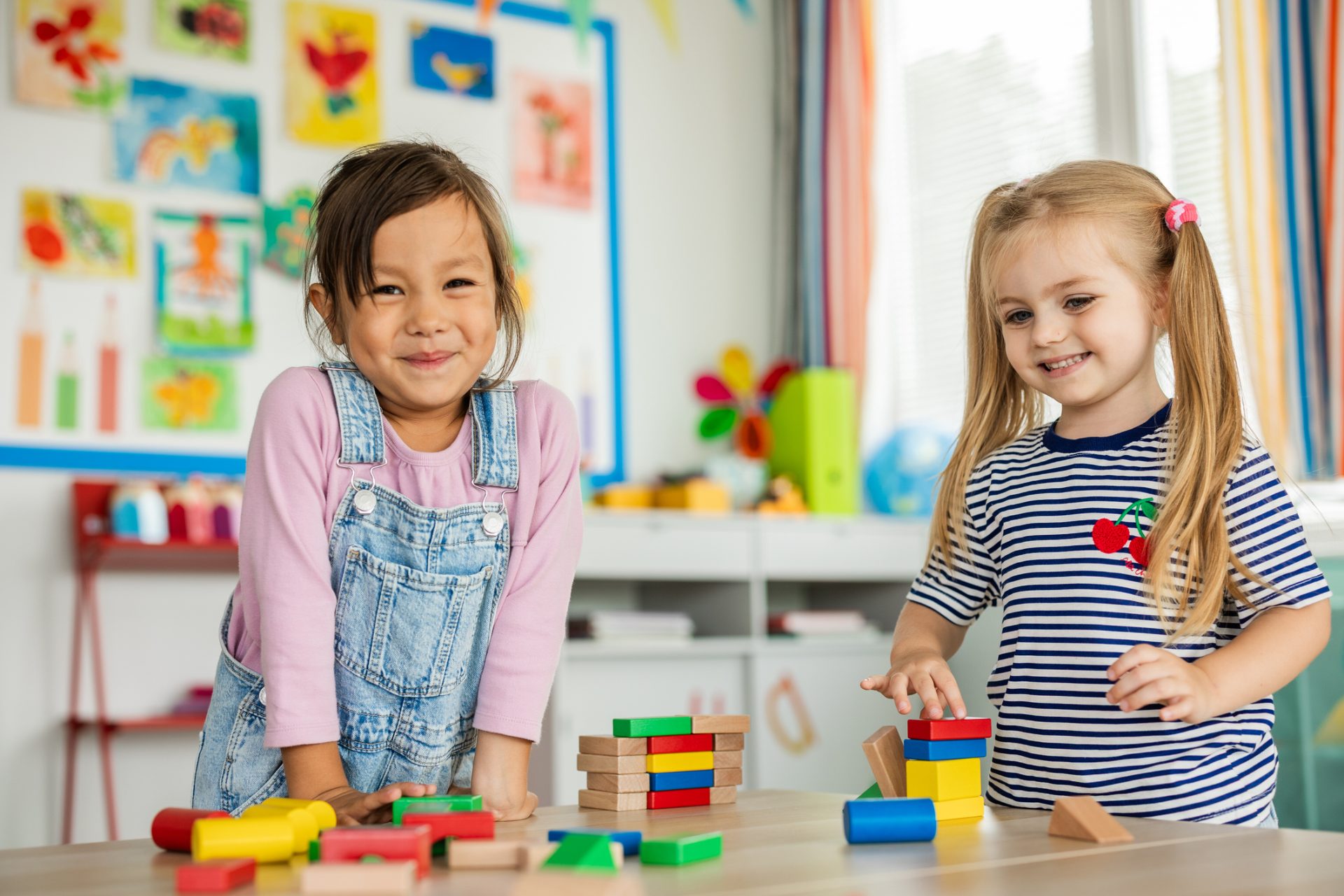
Kindergarten friendships often don’t look like adult friendships. Many kids play side-by-side instead of together, shift between play partners throughout the day, and may not describe having “best friends” in the way parents expect. This is a normal part of early social development and reflects how young kids learn to share space, build comfort around peers, and gradually develop cooperative play skills.
This is the age where “best friend” can mean “the kid who was near the snack table,” which honestly sometimes feels like a very valid friendship system.
When “I played beside someone” is actually a good sign
Kindergarten drop-off often comes with a mix of excitement and quiet uncertainty, for both kids and parents. We imagine our kids running onto the carpet, instantly connecting with a new best friend over blocks or snack time.
Then real life happens.
You pick them up and hear things like:
- “I played beside someone.”
- “I don’t know who I played with.”
- “No one really played with me today.”
And suddenly, it can feel like something is missing, the mama worry sets in.
But early childhood development tells a slightly different story.
According to early learning research, play is one of the primary ways children develop social skills like cooperation, empathy, and communication. In kindergarten, that play doesn’t always look like deep, consistent friendship. More often, it looks like, well, proximity.
They are connecting… it just doesn’t always look the way we expect.

The quiet reality of kindergarten friendships
One of the most common concerns parents have during the first few weeks of school is surprisingly simple: “Is my child making friends?”
The answer is usually yes, but in a very early-stage way.
At this age, friendships are still forming around:
- Who is nearby
- What activity is happening
- Who feels comfortable in the moment
That means your kid might play with several different classmates in a single day without naming any of them as “friends” later. And no, they will not remember the names, but they will absolutely remember who had the “cool blue dinosaur hoodie.” (That counts)
And if that feels a little unstable, that’s because it is. But it’s also exactly how it should be.
Child development guidance from organizations like Zero to Three explains that young children move through stages of play, starting with parallel play where they play beside others before fully engaging with them. This stage is not a stepping stone to “real play.” It is real play. It’s just early social learning in progress.
Two kids might be building separate towers at the same table. Another group might be drawing side-by-side without sharing materials. Others might be running through the same space, each in their own game.
To adults, this can look like disconnection. To educators, it often looks like parallel play, a completely normal stage of development where children learn:
- How to be comfortable near peers
- How to observe social behaviour
- How to gradually enter group play
- How to manage shared spaces and materials
It’s not a lack of friendship. It’s the beginning of social confidence.
The “best friend today, different best friend tomorrow” phase
Another moment that often surprises parents is how quickly friendships shift at this age. One day, your kid is talking about a “best friend.” The next day, that name has changed. And sometimes, there’s no explanation at all.
It’s also completely normal for kindergarteners to have “best friends” whose names they don’t actually remember yet.
At this age, children often connect through play rather than identity, so you might hear descriptions like “the kid with the blue shoes” or “my friend from blocks” instead of names, and that’s just part of how early friendships form.
So when your child’s “best friend” list changes daily, it’s not a sign something is wrong. It’s a sign they’re practicing social connection in real time.
What kids actually mean when they say: “No one played with me today”
This is one of the hardest pickup-line moments for any parent. You hear it, and your instinct is to fix it immediately.
But what’s often happening is not a full-day experience; it’s a snapshot. Kids at this age tend to focus on tricky moments. Even if they spent part of the day happily engaged with peers, that single moment can feel like the whole story to them.
(Think of it as the same way they “never get snacks,” even though you’ve spent your entire summer around getting snacks)
Teachers often see a very different picture. A kid who felt “alone” at recess may have spent the morning happily engaged at centres or sitting beside peers during circle time.
What do healthy kindergarten friendships actually look like?
One of the most helpful shifts for parents is redefining what “friendship” looks like at this age.
It is not long conversations or exclusive bonds.
Instead, it often looks like:
- playing together for 3–10 minutes at a time
- sitting near the same child repeatedly
- copying games rather than creating complex shared ones
- helping clean up together
- laughing during a shared moment and then moving on
These are small, meaningful interactions that build the foundation for later, deeper friendships.
They also reflect what educators consistently observe: social development at this age is gradual, not instant.
How do teachers know if my child is making friends in kindergarten?
Kindergarten teachers spend a lot of time observing how children interact socially, and they often see patterns that don’t come through in end-of-day summaries.
They notice things like:
- a child who consistently sits near the same peer, even without talking much
- a student who watches before joining in, then gradually enters play
- small acts of cooperation during cleanup or transitions
- kids returning to the same activity with familiar classmates over time
These moments matter. They are the building blocks of connection.
And teachers intentionally support this growth through guided interaction, practice, and play-based learning.
When should you be worried about kindie friendships?
If anything feels persistent, ongoing, or distressing; if there’s consistent isolation; if anything is reported by teachers; or if there’s strong avoidance of peers, that’s when a conversation with the teacher or pediatrician is helpful.
But occasional “I didn’t play with anyone today” moments? That’s just kindergarten being kindergarten.
This is less about instant friendship and more about learning how to be part of a group, one interaction at a time.
